

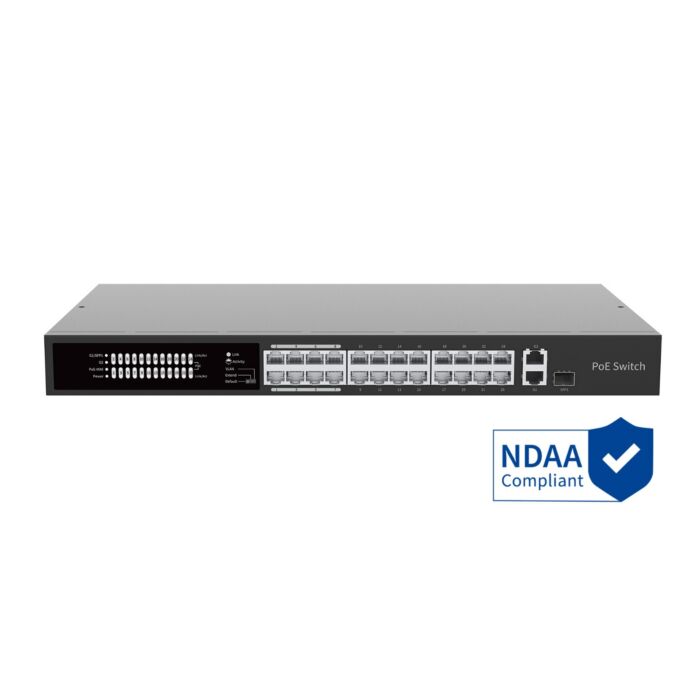


High Power 24 Port PoE+ Plus Switch
Special Price
$350.00
Regular Price
$499.99
30% off
Overview
High Power 24 Port PoE+ Switch - Unmanaged PoE switch for larger IP camera systems, business camera systems, and NVR expansion projects.
370W PoE Budget - Provides 370W total PoE power for compatible 802.3af and 802.3at devices.
24 PoE+ Ports - Powers up to 24 compatible PoE cameras or network devices, with up to 30W per port within the total power budget.
Gigabit Uplink Options - Includes two gigabit RJ45 uplink ports plus one 1000Base-X SFP combo uplink option for supported fiber applications.
Extended PoE Ports - Ports 1 through 8 support extended PoE operation for compatible long cable runs.
Rack Mountable - Fits larger organized network and camera equipment installs.
Unmanaged Setup - Simple connection to an NVR, router, or main switch without managed configuration. NDAA compliant.
24 Port High Power PoE+ Ethernet Network Switch
This high power 24 port PoE+ Ethernet switch provides network connectivity and PoE power for up to 24 compatible devices. With a 370W total PoE power budget, it is well suited for larger network installations that require centralized power and data connectivity, including security camera systems and NVR expansion projects.
Each PoE port carries both power and network data over the same Ethernet cable, reducing the need for separate power supplies at connected devices. The switch can be used to organize IP cameras and other compatible PoE network devices from a central network rack, equipment room, or wiring location.
For network uplink connections, the switch includes two Gigabit 10/100/1000Mbps RJ45 ports for connecting to a router, computer, NVR, or another network switch. It also includes one Gigabit 1000Base-X SFP uplink port that shares bandwidth with the second uplink port, providing an option to use a compatible SFP module for fiber network connections.
As an unmanaged PoE switch, no network management software or controller configuration is required. Connect the switch to your network, then connect compatible PoE cameras or other PoE devices. Each of the 24 PoE+ ports supports IEEE 802.3af and IEEE 802.3at and can provide up to 30W per port as long as the total connected load remains within the 370W PoE power budget.
This switch is UL Listed, FCC Compliant, and NDAA compliant, making it a good fit for customers who need professional network equipment for NDAA compliant security camera systems. It can be used with compatible cameras, NVRs, and network accessories in installations with project-specific equipment sourcing requirements.
When to Use a 24 Port PoE Switch
A 24 port PoE switch is useful when an installation requires more PoE connections than are available on an existing recorder or smaller network switch. It can also be used when multiple network devices are wired back to the same equipment room, network rack, or other central location.
With 24 PoE+ ports plus dedicated Gigabit uplink options, the switch provides room for larger installations while keeping uplink connections available for the recorder, router, or primary network. It is a practical choice for new installations, network expansion, or upgrading from a smaller 8 port or 16 port PoE switch.
Extended PoE for Longer Ethernet Runs
Ports 1 through 8 support extended PoE transmission up to 820ft (250 meters) with compatible low-power PoE devices. This can be useful when a compatible PoE camera must be installed beyond the normal 328ft Ethernet distance limit without using a separate PoE extender.
Extended PoE operates at a reduced network speed to support the longer cable distance. This is suitable for many fixed lens IP cameras whose bandwidth requirements remain within the supported port speed. For long cable runs, use solid copper Cat6 cable and avoid CCA cable.
Features
- 24 port unmanaged PoE+ Ethernet network switch
- 370W total PoE power budget
- 24 x 10/100Mbps PoE+ ports
- IEEE 802.3af and IEEE 802.3at support
- Up to 30W per PoE port within the total connected power budget
- 2 Gigabit 10/100/1000Mbps RJ45 uplink ports
- 1 Gigabit 1000Base-X SFP uplink port that shares bandwidth with the second uplink port
- Ports 1 through 8 support extended PoE up to 820ft (250 meters) with compatible devices
- Compatible with standard 802.3af/at PoE network devices within supported power requirements
- Suitable for IP camera network installations
- UL Listed
- FCC Compliant
- Rack mountable 1U chassis
Centralized PoE for Larger Network Installations
The 24 PoE+ ports make this switch suitable for installations where multiple Ethernet devices need to be powered from one network rack or equipment location. Connected devices can be wired back to the switch while a Gigabit uplink connects the switch to an NVR, router, or primary network.
For security camera installations, this provides a convenient way to power multiple IP cameras from one centralized switch instead of using individual power adapters. The 370W total power budget also provides substantially more available PoE power than many smaller desktop switches.
Because the switch is unmanaged, it does not require a cloud account, subscription, or separate switch-management platform. This keeps installation straightforward for networks that do not require managed switching features.
24 Port PoE+ Switch Compared to a Smaller PoE Switch
| Feature | This 24 Port PoE+ Switch | Smaller PoE Switch |
|---|---|---|
| Typical Use | Larger PoE networks and network expansion | Smaller networks with fewer PoE devices |
| PoE Ports | 24 PoE+ ports | Varies by model |
| Total PoE Budget | 370W | Varies by model |
| Uplink Ports | 2 Gigabit RJ45 uplinks plus 1 shared SFP uplink | Varies by model |
| Extended Distance | Ports 1-8 support extended PoE up to 820ft (250 meters) | Depends on switch capabilities |
| Management Type | Unmanaged | Varies by model |
| Mounting | Rack mountable 1U chassis | Varies by model |
What's Included
- 1x 24 Port PoE+ Switch
- 1x Power Cord
- 1x Pair of Rack Mount Ears
Specifications
| Product Type | 24 Port PoE+ Ethernet Network Switch |
|---|---|
| Switch Type | Unmanaged high power PoE+ switch |
| PoE Ports | 24 x 10/100Mbps RJ45 PoE+ ports |
| Uplink Ports | 2 x 10/100/1000Base-T RJ45 uplink ports, 1 x 1000Base-X SFP uplink port |
| PoE Standards | IEEE 802.3af, IEEE 802.3at |
| PoE Power Budget | 370W |
| PoE Power Output | Up to 30W per port, depending on cable length and total connected load |
| PoE Management | None |
| Switching Capacity | 8.8Gbps |
| Maximum Forwarding Rate | 6.55Mpps |
| MAC Address Table | 16K |
| DHCP | Supports DHCP-Client |
| Long Distance Mode | Up to 820ft (250 meters) with compatible low-power PoE devices on ports 1-8 |
| Network Management | Unmanaged |
| LED Indicators | PWR, PoE, Link/Act LED |
| Input Voltage | 100V-240V AC, 50/60Hz |
| Operating Temperature | 32F to 104F |
| Working Humidity | 10% to 90%, non-condensing |
| Rack Mountable | Yes, includes rack mount ears |
| Weight | 7 lb |
| Dimensions | 17.4 x 9.4 x 1.7 inches (W x D x H) |
| UL Listed | Yes |
| FCC Compliant | Yes |
| NDAA Compliant | Yes |
Frequently Asked Questions
What is a 24 port PoE switch?
A 24 port PoE switch is an Ethernet network switch that provides network connectivity and electrical power to compatible PoE devices over Ethernet cable. This model provides 24 PoE+ ports and a 370W total PoE power budget.
Can this switch power 24 PoE devices?
Yes. The switch can power up to 24 compatible PoE devices as long as the total connected load remains within the 370W PoE power budget and each device remains within the supported per-port power limit.
Can I use this switch with IP security cameras?
Yes. The switch supports compatible IEEE 802.3af and IEEE 802.3at PoE cameras and can provide both power and network connectivity for an IP security camera installation.
Can I connect this switch to an NVR?
Yes. One of the Gigabit uplink ports can connect the switch to an NVR, router, or other network switch depending on the network layout.
What is extended PoE mode?
Extended PoE mode allows ports 1 through 8 to support cable runs up to 820ft (250 meters) with compatible low-power PoE devices. Network speed is reduced when using extended-distance operation.
Is this switch managed or unmanaged?
This is an unmanaged PoE switch. It does not require a cloud account, controller, subscription, or managed switch configuration to operate.
Is this PoE switch UL Listed and FCC Compliant?
Yes. This 24 port PoE+ Ethernet switch is UL Listed and FCC Compliant.
| Brand | CCTVCameraWorld |
|---|---|
| Series | AvaEye |
| Warranty | 1 Year |
| Return Policy | Accessories are non-returnable, non-refundable. |
Write Your Own Review
Product Questions
Can an AvaEye PoE switch run a PoE camera over 300 ft without an extender? The camera I want to use is PoE+ and consumes 13 Watts when the night time infrared LEDs are on.
Question by: Ed on May 18, 2026, 11:32 AM
Yes, this AvaEye PoE switch can be used for camera runs over 300 ft without a separate PoE extender when Extended PoE mode is enabled and the installation uses good quality solid copper Cat5e or Cat6 cable.
A 13 watt PoE+ camera is a reasonable load for this type of setup, even when the infrared LEDs are on at night, as long as the total PoE budget of the switch is not exceeded. The bigger factors are cable quality, distance, camera power draw, and whether Extended PoE mode is supported and enabled on the switch.
For best results, use solid copper cable, avoid CCA cable, and test the camera before final installation. Extended PoE mode may reduce network speed on that port, but that is usually fine for security cameras. Higher power devices, PTZ cameras, heaters, poor cable, or very long runs may still require a PoE extender, fiber, or a different network design.
A 13 watt PoE+ camera is a reasonable load for this type of setup, even when the infrared LEDs are on at night, as long as the total PoE budget of the switch is not exceeded. The bigger factors are cable quality, distance, camera power draw, and whether Extended PoE mode is supported and enabled on the switch.
For best results, use solid copper cable, avoid CCA cable, and test the camera before final installation. Extended PoE mode may reduce network speed on that port, but that is usually fine for security cameras. Higher power devices, PTZ cameras, heaters, poor cable, or very long runs may still require a PoE extender, fiber, or a different network design.
Answer by: CCTV Camera World on May 18, 2026, 12:47 PM
Related Products
Check items to add to the cart or