

 4K Security Camera
 PoE Camera
 PTZ Camera
 Smart Security Camera
 Wireless Security Camera
 License Plate Camera
Outdoor Security Cameras
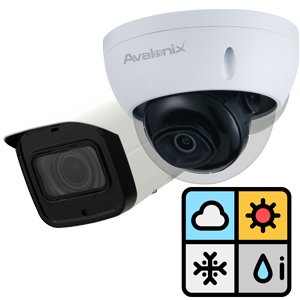
All CCTV Camera World outdoor security cameras are weatherproof with an IP66 rating and designed for year-round use. They are suitable for homes and businesses and are straightforward enough for DIY users while still offering the features installers and commercial users expect. They can be installed around driveways, gates, yards, parking areas, building entrances, and other exterior locations. We offer wired PoE cameras and analog BNC cameras for permanent installations, along with WiFi cameras for quick plug-and-play setup.
Many of our PoE and WiFi cameras can be used on their own without a recorder. Compatible cameras can be added to our free mobile apps by scanning a QR code, and supported models can record locally to a microSD card with no required monthly subscription. They can also be connected to a compatible NVR or DVR for continuous recording and larger storage capacity.
CCTV Camera World also carries outdoor cameras for expanding or replacing equipment in existing systems. Many of our PoE and IP cameras support ONVIF and can work with compatible third-party NVRs, while analog BNC cameras can often reuse coax wiring that is already installed.
Shop by Type
Shop Outdoor Security Cameras
-

-
Analog Bullet BNC Security Camera with Motion Detector Sensor PIRSKU: PIREYE$79.99 $149.99 47% off
-
-
-
-
-
-
-
-
-
2MP 1080P PoE Bullet Camera with built-in Mic, Weather Proof, AvaEyeSKU: IP2MPBLA$129.99 $179.00 27% off
-
-
-
-
-
-
-
-
Long Range Night Vision 1080P Analog Bullet Camera, 5X Zoom, 12V DCSKU: HDBLDV12V$219.99 $299.99 27% off
-
Why Buy Outdoor Security Cameras from CCTV Camera World?
Professional-quality cameras do not have to be difficult to choose or install. CCTV Camera World supplies outdoor cameras for DIY homeowners, businesses, and professional installers. Every camera in this category is weatherproof with an IP66 rating or better for permanent outdoor installation.
What matters most is choosing a camera that can actually do the job at your location. Viewing distance, lens angle, resolution, night vision, mounting height, and lighting all affect how useful the recorded video will be. We provide camera specifications, real-world viewing information, product videos, and technical support to help customers choose the right model before ordering.
Whether you need to watch a front entrance, driveway, gate, backyard, parking lot, loading dock, or an existing camera location, we can help match the camera to the area you need to cover.
Need a Complete Outdoor Camera System?
If you need cameras and a recorder together, shop complete systems designed for homes or businesses.
Home Security Camera Systems
Complete camera and recorder systems for homes and residential properties.
Business Security Camera Systems
Complete surveillance systems for offices, stores, warehouses, and commercial properties.
Best Outdoor Security Cameras by Location
The best outdoor camera depends on where it will be installed and what you need to see. A camera watching a front door from 10ft away has a different job than a camera watching the end of an 80ft driveway. Use the table below as a starting point when comparing cameras.
| Area | What to Look For | Good Camera Choices |
|---|---|---|
| Front Door / Porch | Facial detail at close range, enough width for the doorway or packages, and useful alerts or two-way communication | Turret cameras, dome cameras, or active deterrence cameras |
| Driveway | Enough detail at the actual viewing distance, useful night vision, and person or vehicle detection where alerts are important | Bullet cameras, motorized zoom cameras, or AI cameras |
| Backyard / Side Yard | A practical field of view for gates, fences, patios, sheds, and areas people may approach after dark | Turret cameras, bullet cameras, or panoramic cameras |
| Parking Lot / Loading Dock | Longer viewing distance, dependable night vision, smart detection, and continuous recording | Bullet cameras, motorized zoom cameras, active deterrence cameras, or PTZ cameras |
| Large Open Area | Coverage of the overall scene with closer coverage at important entrances, gates, or vehicle lanes | Panoramic or fixed cameras, with PTZ cameras where active monitoring is useful |
How Much Camera Resolution Do You Need?
Resolution is more useful when you compare it with viewing distance. A 4K outdoor security camera gives you considerably more image detail than a 1080P camera, but resolution alone does not determine how clearly you will see a person or vehicle. Lens angle, lighting, mounting height, and the distance between the camera and subject also matter.
The chart below is based on the type of professional image sensors used in the cameras we sell and shows the level of detail you can generally expect at common distances.
A higher resolution camera gives you more pixels to work with, but it cannot make up for a view that is too wide. If the person or vehicle you need to see is farther away, choosing the right lens can be just as important as moving from a lower resolution camera to 4K.
Compare Outdoor Camera Night Vision
Outdoor cameras can use infrared, low-light or starlight technology, or visible white light at night. Do not judge a camera only by the advertised night vision distance. Seeing activity at 150ft is not the same as capturing enough detail to identify a face at 150ft.
Need More Detail Farther Away? Consider Motorized Zoom
Digital zoom enlarges pixels that have already been captured. A motorized zoom camera uses optical zoom to change the lens and narrow the field of view. This puts more image detail on a driveway entrance, gate, parking space, or other area farther from the camera.
If a wide-angle camera shows the entire property but makes the person or vehicle you care about too small, a tighter lens may be the better choice.
Professional Outdoor Cameras That Are Easy to Set Up
There are several ways to install an outdoor camera from CCTV Camera World depending on the property.PoE cameras use one Ethernet cable for both power and video, making them a simple choice when network cable can be run to the camera. WiFi cameras are useful where running Ethernet is inconvenient but there is a nearby power outlet, while analog BNC cameras are a practical option when coax wiring is already in place or you would rather not have a digital camera due to privacy reasons.
You can start with a single camera or build out a larger installation over time. The standalone app, local recording, and recorder options described above give you flexibility without requiring every installation to be designed the same way.
You also do not have to connect every camera on a property the same way. Our DVR and NVR systems can combine compatible wired and WiFi cameras, which is useful when most locations are easy to cable but a gate, garage, or detached building is not.
Replacing Cameras on an Existing Security System?
A failed or outdated outdoor camera does not necessarily mean the entire security system needs to be replaced. We carry replacement PoE/IP and analog BNC cameras for many existing DVR and NVR installations, including systems originally purchased from other companies. Many of our PoE/IP cameras support ONVIF for use with compatible third-party NVRs. Analog BNC cameras can also work with many existing DVRs when the recorder supports the camera's video format and resolution.
Compatibility depends on the recorder and camera. If you are unsure which model will work with your existing equipment, send us the manufacturer and model number of your recorder before ordering.
Frequently Asked Questions about Outdoor Security Cameras
Are CCTV Camera World outdoor security cameras weatherproof?
Yes. The outdoor security cameras in this category have an IP66 weatherproof rating or better for permanent exterior installation. Properly installed cameras can be used year-round around homes and businesses, subject to the operating temperature specifications of the individual model.
Can I use an outdoor security camera without a DVR or NVR?
Yes. Compatible PoE and WiFi cameras from CCTVCameraWorld can be used as standalone cameras with our free mobile apps. Models with microSD card support can also record locally without a DVR or NVR. A recorder becomes useful when you want continuous recording, more storage, or several cameras managed together.
Will your outdoor cameras work with my existing security system?
Many CCTVCameraWorld outdoor cameras can work with compatible systems from other manufacturers. Many of our PoE/IP cameras support ONVIF for compatible third-party NVRs. Analog BNC cameras can also work with many existing DVRs when the recorder supports the camera's video format and resolution. Contact us with your recorder model number if you are unsure.
Can wired and WiFi cameras be used together?
Yes, on supported systems. Compatible PoE or network cameras and WiFi cameras can be used together with many NVRs. Hybrid DVRs can also support analog BNC cameras along with compatible IP or WiFi cameras. This lets you choose the connection that makes the most sense for each camera location.
Do outdoor security cameras need internet?
No. Local recording does not require an internet connection. Internet is primarily used when you want to view the cameras remotely, receive app alerts, or connect supported equipment to an optional third-party service.
How far can outdoor security cameras see at night?
Night vision range and useful identification distance are not the same thing. Lens angle, resolution, lighting, and distance all affect facial detail. For many models, CCTVCameraWorld provides real-world viewing and facial-detail distances in our product descriptions and individual camera test videos.
Do I have to pay monthly fees for outdoor security cameras?
No. CCTVCameraWorld does not require a monthly subscription for local video recording. Compatible cameras can also be integrated with third-party cloud platforms if you choose to use one.