


Can One Joystick Control Your PTZ Camera and NVR?
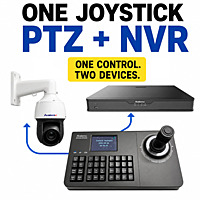
Can one physical joystick control a PTZ camera and the camera views displayed by an NVR? In this hands-on demonstration, Ray from CCTV Camera World uses the AvaEye KB110E to switch camera channels, change the NVR's HDMI grid layout, and control pan, tilt, optical zoom, and focus on an AvaEye PTZ camera.

What This AvaEye PTZ Joystick Demonstration Shows
Test result: the AvaEye KB110E can control a compatible PTZ camera while also sending channel and display-layout commands to an AvaEye NVR. The operator can select fixed or PTZ camera views, return to a multi-camera grid, and control the selected PTZ without using a mouse for normal operation after the system is configured and logged in.
The system shown uses an AvaEye 16-channel NVR, two fixed bullet cameras, and an AvaEye 5MP mini PTZ camera on the same local network. Static IP addresses and a configured device ID keep the joystick, NVR, and cameras communicating at predictable network locations.
The video also explains an important limitation: the joystick cannot type a password into the NVR's HDMI login screen. A mouse may still be needed for initial login or configuration, so the access and security requirements should be planned before installation.
Need Help Building a PTZ Camera System?
Call CCTV Camera World at (716) 229-0080 or use our contact form. We can help select and configure a compatible NVR, fixed cameras, PTZ cameras, PoE equipment, joystick controller, and local or remote viewing options.

Products Used in This Video
- AvaEye KB110E PTZ Joystick Controller
- AvaEye NVR216P 16-Channel 4K PoE NVR
- AvaEye PTZ5MP4X 5MP Mini PTZ Camera with 4X Optical Zoom
Browse more professional PTZ cameras, network video recorders, and complete security camera systems from CCTV Camera World.
Video Transcript
Open the cleaned, timestamped transcript below to read the complete joystick, NVR display, channel-selection, and PTZ-control demonstration.
View transcript: Can One Joystick Control Your PTZ Camera and NVR?
00:00 - Professional PTZ joystick and NVR control
Ray introduces a professional AvaEye camera system that combines an NVR, a KB110E PTZ joystick controller, fixed bullet cameras, and a PTZ camera. The purpose of the demonstration is to show that one physical controller can operate the PTZ and control the camera views displayed through the NVR's HDMI output.
00:35 - AvaEye NVR, PTZ, and network setup
The AvaEye NVR is connected to the cameras through the local network and PoE equipment. Two fixed bullet cameras and one PTZ camera are assigned static IP addresses so the devices remain at consistent network locations. CCTV Camera World can configure the NVR, cameras, and joystick before shipping.
01:18 - Important NVR password requirement
Ray explains that the controller can send commands to the NVR but cannot type a password into the NVR's HDMI login screen. A mouse may therefore be required for login. For special installations such as a crane cab or confined control station, the login workflow should be planned before deployment.
02:06 - Logging in and selecting NVR mode
Ray unlocks the controller, logs in, selects NVR mode, and chooses the device ID assigned to the recorder. The controller is configured to communicate with the NVR rather than controlling only one camera directly.
02:50 - Switching between camera channels
To open a camera, enter its channel number and press CAM. Ray switches between the fixed cameras and the PTZ channel while the selected channel number appears on the NVR display.
03:25 - Selecting the PTZ camera
After selecting the PTZ channel, Ray enables PTZ control so the joystick commands are sent through the NVR to the camera.
03:36 - Controlling pan, tilt, optical zoom, and focus
Moving the joystick left or right pans the camera, while moving it forward or backward tilts the camera. Rotating the joystick dial controls optical zoom. Dedicated buttons can also adjust zoom and manual focus on supported cameras.
04:35 - Returning to the four-camera grid
To return from a single camera to the four-camera display, Ray enters 4 and presses MULT. If the controller is still in PTZ mode, press Escape first and return to the normal NVR control mode before changing the grid.
05:16 - Why Ray does not recommend selecting grid cells with the joystick
Although the joystick can sometimes move a highlight around the NVR grid, the selection is difficult to see and may not move predictably between every cell. Ray recommends entering the channel number and pressing CAM instead.
06:01 - Using Next, Previous, and CAM
The Next and Previous buttons cycle through connected camera channels. For direct access, enter the exact channel number and press CAM. These controls are more reliable for changing views than trying to navigate the grid with the joystick itself.
07:00 - Switching between 8, 9, and 16-camera views
The controller can request different NVR display layouts. Ray demonstrates 8, 9, and 16-camera views. The available grids depend on the capacity and display options of the connected NVR.
07:36 - Controlling additional PTZ functions
Compatible cameras may expose additional functions such as a wiper or other PTZ accessories. The exact commands available depend on the selected PTZ camera and its supported features.
07:50 - Final overview
Ray concludes that the KB110E can control both a compatible PTZ camera and the view displayed by an AvaEye NVR. It gives the operator physical control of pan, tilt, optical zoom, focus, channel selection, and supported multi-camera layouts.
How One Joystick Controls the PTZ and NVR
The KB110E is configured to communicate with the AvaEye NVR over the local network. Instead of being tied to only one camera, it sends channel-selection, display-layout, and PTZ commands through the recorder.
This gives a security operator one physical control surface for two related tasks: choosing what appears on the NVR monitor and moving the selected PTZ camera. Fixed cameras can be opened for viewing, while PTZ channels also provide pan, tilt, zoom, focus, and supported accessory commands.
Switch Between Fixed Cameras and PTZ Cameras
Enter the desired channel number and press CAM to open that camera. The video demonstrates switching between two fixed bullet cameras and the PTZ camera. Once the PTZ channel is selected, enable PTZ mode and use the joystick for movement.
Ray recommends using the CAM, Next, and Previous buttons rather than trying to move a small highlight around the NVR grid with the joystick. Direct channel selection is easier to see and more predictable.
Control Pan, Tilt, Optical Zoom, and Focus
Move the joystick left or right to pan and forward or backward to tilt. Rotate the joystick dial to control optical zoom. Dedicated buttons provide additional zoom and manual focus adjustments on supported cameras.
A physical joystick is especially useful when an operator actively follows a person, vehicle, gate, loading area, warehouse aisle, or other moving activity. It provides smoother hands-on control than repeatedly clicking directional controls with a mouse.
Change the NVR's HDMI Grid Layout
The MULT command changes the multi-camera view sent through the NVR's HDMI output. In the demonstration, Ray uses 4 + MULT to return to a four-camera grid and also shows 8, 9, and 16-camera layouts.
The exact layouts available depend on the NVR's channel capacity and supported display modes. If the controller is still in PTZ mode, press Escape before requesting a new grid.
Important NVR Login and Password Note
The joystick can send commands to the recorder, but it cannot type a password into the NVR's HDMI login screen. A mouse may therefore still be required for initial login, setup, maintenance, or any locked recorder screen.
This matters in crane cabs, confined workstations, control stations, and other locations where a mouse is not convenient. Discuss the login workflow and security tradeoffs with CCTV Camera World before the system is configured. Do not disable access controls without considering who can physically reach the recorder and monitor.
Use Fixed and PTZ Cameras on the Same NVR
An AvaEye NVR can display and record compatible fixed bullet, dome, turret, and PTZ cameras together. Fixed cameras can maintain continuous views of important areas while an operator uses the PTZ to follow movement or inspect activity more closely.
This type of setup is useful for control rooms, warehouses, manufacturing facilities, parking areas, construction sites, schools, crane stations, commercial properties, and other applications where someone actively monitors the camera system.
Local Operation Without Internet
The joystick, NVR, PoE switch, and cameras can operate together on a properly configured local network without internet access. The NVR can record and display the cameras while the joystick sends local control commands.
Internet is only needed when remote viewing, off-site software access, app connectivity, or alerts outside the local network are required.
ONVIF and Third-Party Camera Compatibility
The KB110E supports ONVIF-based control and may work with compatible third-party PTZ cameras and recorders. CCTV Camera World has tested the controller with select products from several manufacturers, but ONVIF support does not guarantee that every feature will work on every model.
Compatibility can depend on the exact camera, firmware, recorder, network settings, ONVIF implementation, and user permissions. Contact CCTV Camera World before ordering if the controller will be used with non-AvaEye equipment.
Tested and Configured by CCTV Camera World
This page is based on a real bench demonstration performed by Ray at CCTV Camera World. The video shows the actual KB110E, AvaEye NVR, fixed cameras, PTZ camera, HDMI display, channel commands, grid changes, and live PTZ movement rather than relying only on a product specification sheet.
CCTV Camera World can configure compatible AvaEye cameras, NVRs, static IP addresses, device IDs, and joystick settings before shipping when requested.
Frequently Asked Questions
Can one PTZ joystick control both a PTZ camera and the NVR display?
Yes. In the AvaEye system shown, the KB110E communicates with the compatible NVR. The operator can select camera channels, change the NVR's HDMI grid layout, and then control pan, tilt, optical zoom, and focus on the selected PTZ camera.
Can the joystick switch between fixed cameras and PTZ cameras?
Yes. Enter the desired channel number and press CAM to display that camera. Fixed cameras can be selected for viewing, while compatible PTZ cameras can also be moved and zoomed after PTZ control is enabled.
Can the joystick change the NVR's multi-camera grid?
Yes. The MULT command can switch the NVR display to supported layouts such as 4, 8, 9, or 16 cameras. Available layouts depend on the recorder's channel capacity and supported display modes.
Do I still need a mouse connected to the NVR?
A mouse may still be needed for initial setup, configuration, and any NVR login screen that requires a password. After the system is configured and logged in, the joystick can handle the normal channel switching, grid selection, and PTZ control shown in the video.
Why does the NVR password matter when using the joystick?
The joystick can send commands to the NVR, but it cannot type a password into the NVR's HDMI login screen. In installations where a mouse is not readily available, discuss the login requirements and security tradeoffs with CCTV Camera World before the system is configured.
Can the KB110E control more than one PTZ camera?
Yes. The controller can be configured for compatible systems with multiple PTZ cameras. Select the appropriate camera channel or configured device before using the joystick to pan, tilt, zoom, or focus.
Does the PTZ joystick system require internet?
No. The joystick, NVR, PoE switch, and cameras can operate together on a properly configured local network without internet. Internet is only needed for remote viewing or off-site access.
Will the KB110E work with third-party ONVIF cameras?
It may work with compatible third-party ONVIF PTZ cameras and recorders, but ONVIF does not guarantee that every command or feature will work. Compatibility depends on the camera model, firmware, recorder, network settings, and user permissions.